PREZODE co-organized events in the framework of the 2026 One Health Summit held on April 6-7, 2026.
Across nine events within the “One Health Festival”, PREZODE and its partners showcased concrete, regionally grounded actions that connect science, policy and communities to reduce the risk of zoonotic emergence, strengthen surveillance systems and support sustainable food systems.
PREZODE’s engagement at the One Health Summit
As an international initiative dedicated on prevention of zoonotic disease emergence, PREZODE is completely aligned with the One Health approach, proposing co-designed, evidence-based solutions to protect human, animal and environmental health. In the framework of the One Health Summit, PREZODE focuses on operationalising One Health across sectors and regions. Thought PREACTS programme in the Global South, and a range of local projects, PREZODE highlights its bottom-up approach, creating community participation, science-policy dialogue and capacity building as essential pillars of effective One Health implementation.
1. ASEACA/COHESA Regional workshop “Codesigning a regional One Health network”
Date: 24-26 March, Harare
With the final year of the COHESA project and the onset of the ASEACA project, a workshop bringing together stakeholders from 12 Eastern and Southern African countries, alongside representatives of the Quadripartite, Africa CDC, the African Union, the European Union, and the World Bank, convened in Harare from the 23rd to the 27th of March 2026. Building on a participatory process initiated in Cape Town in September 2024, the workshop continued the co-design of a future regional One Health network within the COHESA network legacy in promoting One Health governance, training the future OH workforce, and operationalising One Health on the ground.
2. Launch of ASEACA Philippines: Prevention and One Health Early Warning
Date: 26-27 March, Manilla
This One Health Festival edition officially launched the ASEACA project Philippines, the country component of PREACTS, dedicated to prevention and early warning at the human, animal, environment interface. Organized in Manila by SEARCA with CIRAD and ILRI as co‑leads and supported by the French Embassy in the Philippines, the event brought together national and local stakeholders to present the programme’s objectives, governance, and implementation roadmap, and consolidate priorities identified in Pampanga and Bukidnon, locations where the ASEACA is being implemented. The event validated the national theory of change and agreed on coordination mechanisms, technical working groups, and a 2026–2027 work plan, with a specific focus on community‑based One Health surveillance and ethical data governance.
3. Mapping Community-Led One Health Interventions for Prevention and Early Warning
Date: 31 March, Bangkok
Organised in Bangkok in March by APCASO in collaboration with CIRAD under the ASEACA project, this workshop sought to strengthen engagement with civil society organizations (CSOs) and community partners across the 16 APCASO partner countries through mapping ongoing and planned One Health activities. This process supports the development of evidence-based and strategic intervention recommendations. Through a combination of preparatory virtual work, a one‑day in‑person strategic workshop, and follow‑up webinars, participants were invited to identify ongoing and planned activities, priority intervention areas, and opportunities for alignment, to formulate coordinated, evidence‑informed recommendations for disease prevention and One Health interventions aligned with national priorities, including for Global Fund GC8 proposals.
4. ASEACA Viet Nam Launch: Strengthening One Health Governance and Science–Policy Dialogue
Date: 17th-18th March, Hanoi
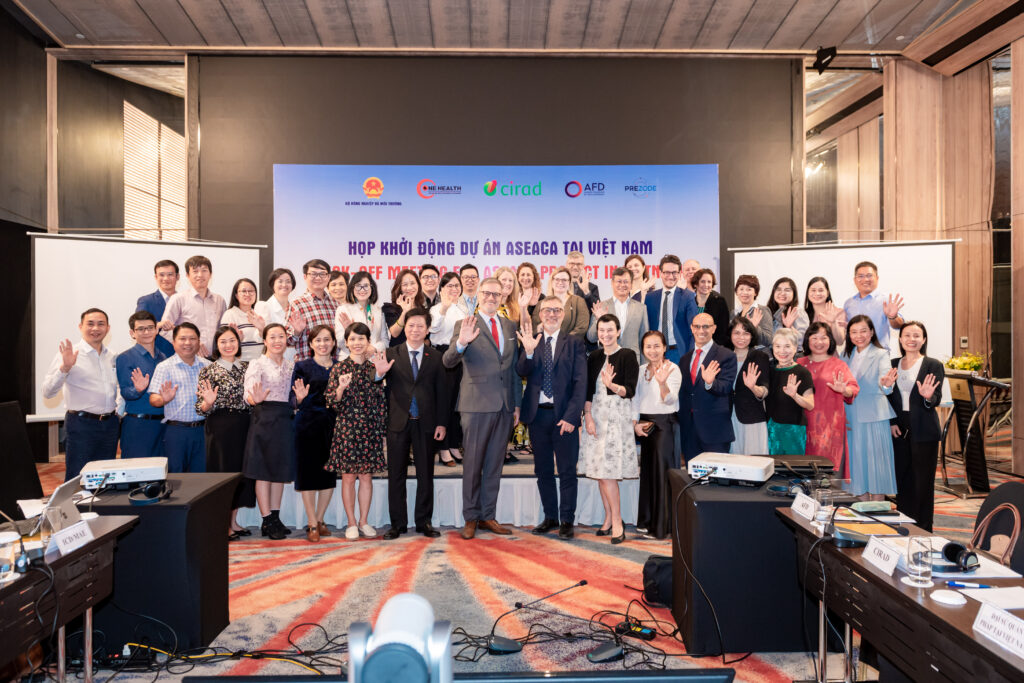
The One Health Festival event was the framework of the launch of ASEACA in Vietnam, the country component of PREACTS, with a strong focus on One Health governance and science–policy dialogue. Led by the Viet Nam One Health Partnership with CIRAD as co‑lead and supported by the French Embassy, the event convened national and provincial stakeholders to present project objectives, governance and implementation roadmap, consolidate priorities from Thai Nguyen and Dong Thap into a shared national Theory of Change, and establish coordination modalities and an indicative 2026–2027 workplan, while initiating a structured reflection on research‑to‑policy mechanisms to support timely uptake of ASEACA outputs.
5. One Health for Cambodia
Date: 2nd April, Phnom Penh
The inter‑ministerial coordination committee on One Health (IMCC‑OH) in Cambodia held an event to explore key One Health challenges and opportunities in the country. Introductory remarks were delivered by the French Ambassador and the Ministers of Health, Agriculture, Forestry and Fisheries, and Environment. The event comprised three thematic sessions:
- Zoonotic diseases and vector-borne diseases: H5N1 as an example of trans-sectorial issue and examples to showcase how One Health data production can directly support public health action.
- Antimicrobial resistance (AMR): The role of Cambodia’s Multi-sectoral AMR Technical Working Group and the implementation of the Multi-sectoral Action Plan on AMR with a focus on the human–animal–environment interface.
- Agricultural perspective on One Health: emphasising how access to safe and secure food through agroecology is essential to public health in a context of rapid agrarian change.
6. Upscaling the SIT to control Aedes mosquitoes in a One Health perspective
Date: 8th April, Montpellier
CIRAD and partners co-organized with PREZODE a workshop on scaling-up sterile insect technique (SIT) to control genetically Aedes mosquitoes that transmit arboviruses such as dengue and chikungunya. Drawing on experience from Réunion Island, where an automated sterile male release system and the ARBOCARTO predictive mapping tool for mosquito population densities are being deployed, the event examined how integrated tools can optimise genetic control, reduce costs, and support regional transfer to the Caribbean and Indian Ocean. Representatives from more than 10 countries, including advanced SIT programmes and mosquito control actors from health ministries and regional health agencies, discussed financing models and territorial targeting strategies for sustainable vector control in a One Health perspective.
7. CaribVET General Assembly and One Health session
Date: 23-25 March, Orangestad
The Caribbean Animal Health Network (CaribVET) in collaboration with CIRAD, the United States Department of Agriculture (USDA), the Caribbean Agricultural Health and Food Safety Agency (CAHFSA), and the Secretariat of the Caribbean Community (CARICOM), organized the 7th CaribVET General Assembly. During this event, members were invited to share health and sanitary risk information to improve risk mitigation and protection of the Caribbean. A specific session focused on the One Health approach deployed by the different international and regional organisations at the regional level. Another session was dedicated to disaster response. The General Assembly also hosted the kick-off meeting of the ASEACA project.
8. Reducing pesticide and antibiotics use in tropical agriculture for human and ecosystem health
Date: 8th April – 15h, Online
This online session addressed the overreliance on pesticides and antibiotics in tropical agriculture and its implications for human, animal, and environmental health, including resistance development and the erosion of food system resilience. Drawing on expertise from health, environmental, and agricultural sciences as well as frontline food‑system actors, the event highlighted parallels and differences between antibiotic and pesticide use, articulated shared risks to One Health outcomes, identified challenges and opportunities to collaborate on a strategic multistakeholder road map to build, over 2026, recommendations for science and policy to reduce harmful biocide use while safeguarding food security.
More info
9. AquASEAN: Circular Aquaculture and Global Health for Sustainable Aquatic Systems in South East Asia
Date : 3 April – 15h30 at the French Embassy in Bankok or online
Held in Bangkok on 2–3 April 2026, this event marked the official launch of the AquASEAN Partnership for Sustainable Aquaculture project, a regional initiative led by CIRAD with support from the French diplomatic network and endorsed by the ASEAN Secretariat. Bringing together public, academic, and private stakeholders, the event aimed to underscore the shared vision for sustainable, circular, and climate‑responsible aquaculture in Southeast Asia, highlighting pilot integrated circular aquaculture systems, structured public‑private partnerships, capacity‑building activities, and support to public policies, to reconcile economic performance, ecosystem health, and regional food security.