The One Health ASEAN–France Scientific Conference, held on November 25–26, 2025, in Jakarta (Indonesia), brought together leading institutions and experts to strengthen regional cooperation on emerging health challenges.
The two-day conference held on November 25-26 in Jakarta aimed to reinforce ASEAN–France collaboration through collective and synergized actions for the prevention, detection, and response to communicable diseases, emerging infectious threats, public health emergencies, and future pandemics, all of which must be grounded in solid scientific evidence.
The event was organized by the CNRS, the Embassy of France in Indonesia and Timor-Leste, the Indonesian Ministry of Health, and ASEAN, in collaboration with IRD and CIRAD, with support from BRIN, Indonesia’s National Research and Innovation Agency.
Bringing together a wide range of One Health actors from across the region, the conference served as a dynamic platform to discuss interconnected health challenges at the human–animal–environment interface. Discussions emphasized the crucial role of environmental health—including biodiversity loss, ecosystem degradation, and pollution—in shaping human vulnerability to emerging pathogens.
The integrated and participatory approaches of PREZODE
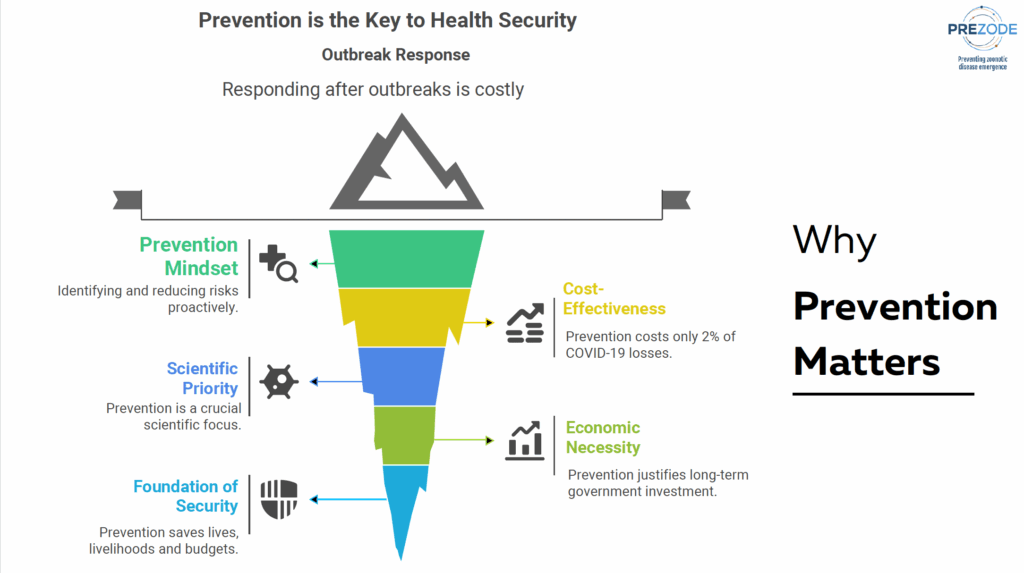
During the event, Dr. Soawapak Hinjoy, Vice President of the PREZODE General Assembly, introduced the Initiative, emphasizing its vision to prevent zoonotic risks through integrated, participatory approaches. She highlighted why prevention matters.
Dr. Serge Morand, as Principal Investigator (PI) of ASAMCO in Lao PDR and Thailand, Dr Flavie Goutard, PI of ASEACA in Vietnam and Philippines, and Dr. Anne-Laure Bañuls, PI of AfriCam in Cambodia, presented the three phases of the PREACTS program. They highlighted ongoing transdisciplinary research, surveillance innovations, and capacity strengthening across Africa, South America, and Southeast Asia.
Importantly, a discussion was initiated with ASEAN to explore the possibility for PREZODE to be part of ASEAN’s international partnership, opening new perspectives for long-term regional collaboration on pandemic prevention.